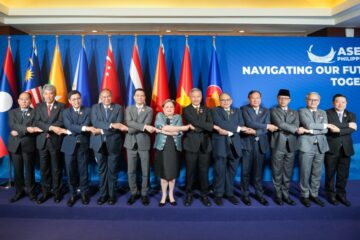
Thailand has reaffirmed its commitment to supporting Myanmar towards full participation in ASEAN, signalling continued efforts to strengthen dialogue, regional stability and practical cooperation between the neighbouring countries amid ongoing discussions over Myanmar’s relationship with the regional bloc.
The commitment was outlined in a joint statement issued on 6 August, following Myanmar President Min Aung Hlaing’s two-day official visit to Thailand and meeting with Thai Prime Minister Anutin Charnvirakul. Myanmar, in turn, expressed appreciation for Thailand’s role in facilitating efforts towards normalising its relations with ASEAN.
Thailand Advocates “Calibrated Re-Engagement”
Thailand has increasingly positioned itself as a bridge between Myanmar and ASEAN, advocating what it describes as a “calibrated re-engagement” approach.
Thai Foreign Minister Sihasak Phuangketkeow said Bangkok’s engagement reflects the practical realities of sharing a border with Myanmar and the need to address challenges that directly affect both countries. Thailand has maintained that dialogue can play an important role in encouraging peace and stability while addressing immediate cross-border concerns.
The approach also reflects Thailand’s broader commitment to ASEAN. During a policy speech at the ASEAN Secretariat on 4 August, Prime Minister Anutin highlighted Thailand’s support for advancing ASEAN 2045: Our Shared Future, which seeks to build a more resilient, innovative, dynamic and people-centred regional community.
Expanding Bilateral Cooperation
Beyond discussions surrounding ASEAN participation, Thailand and Myanmar agreed to deepen dialogue and cooperation across several important areas.
The two sides identified security, trade, investment, energy and transnational crime among their priorities, alongside cooperation on shared cross-border challenges.
During the official visit, agreements were also reached covering areas including migrant labour cooperation, water quality management and space technology for Earth observation. These initiatives demonstrate an effort to strengthen practical bilateral engagement alongside broader diplomatic discussions.
Greater cooperation is particularly significant for Thailand because instability in Myanmar can have direct implications for border security, migration, illicit trade and economic activity in neighbouring areas.
ASEAN’s Five-Point Consensus Remains Central
Myanmar’s participation in ASEAN remains a complex regional issue.
ASEAN has restricted Myanmar’s top political leadership from participating in its major meetings since the military takeover in February 2021. The bloc subsequently adopted its Five-Point Consensus, which includes commitments towards ending violence, promoting constructive dialogue and facilitating humanitarian assistance.
Thailand has continued to urge Myanmar to reduce hostilities while arguing that maintaining channels of communication could contribute to longer-term progress.
However, any return to full participation in ASEAN would require agreement among the bloc’s members. Sihasak emphasised that the issue ultimately depends on ASEAN consensus and that Thailand would not seek to impose its approach on other member states.
Balancing Engagement With Regional Consensus
Thailand’s strategy comes as ASEAN members continue debating how best to address the prolonged crisis in Myanmar.
Supporters of engagement argue that sustained communication may create opportunities for dialogue and practical cooperation, particularly given Myanmar’s geographical and economic integration with Southeast Asia. Critics, however, have warned that high-level engagement could risk granting political legitimacy without sufficient progress towards ASEAN’s peace framework.
This places ASEAN in the challenging position of balancing its principles and Five-Point Consensus with the practical need to maintain regional stability and address humanitarian and cross-border consequences.
Strengthening ASEAN Unity and Stability
For ASEAN, developments in Myanmar remain closely connected to the bloc’s wider ambitions for regional integration.
A peaceful and stable Myanmar would contribute to stronger economic connectivity, more secure borders and greater cooperation across mainland Southeast Asia. Progress could also strengthen ASEAN’s ability to respond collectively to regional challenges while reinforcing confidence in its consensus-based diplomatic framework.
Thailand’s willingness to maintain dialogue therefore represents one pathway towards encouraging greater engagement, although the pace and conditions of Myanmar’s eventual return to full ASEAN participation will continue to depend on collective agreement among member states.
Looking Ahead
Thailand’s renewed support for Myanmar’s full participation in ASEAN signals an important development in regional diplomacy, with Bangkok seeking to combine practical bilateral cooperation with efforts to reconnect Myanmar more closely with the regional community.
The path forward remains complex, particularly as ASEAN continues to emphasise peace, humanitarian access and implementation of its Five-Point Consensus. Nevertheless, continued dialogue could provide opportunities to address immediate cross-border challenges while creating conditions for longer-term political and regional progress.
As ASEAN works towards a more resilient and integrated community under its ASEAN 2045 vision, developments surrounding Myanmar will remain an important test of the bloc’s ability to balance national interests, consensus and its commitment to regional peace and stability.