ASEAN must move beyond discussions on battery technology and accelerate manufacturing, commercialisation, investment and regional standards if Southeast Asia is to establish itself as a competitive force in the rapidly expanding global battery industry.
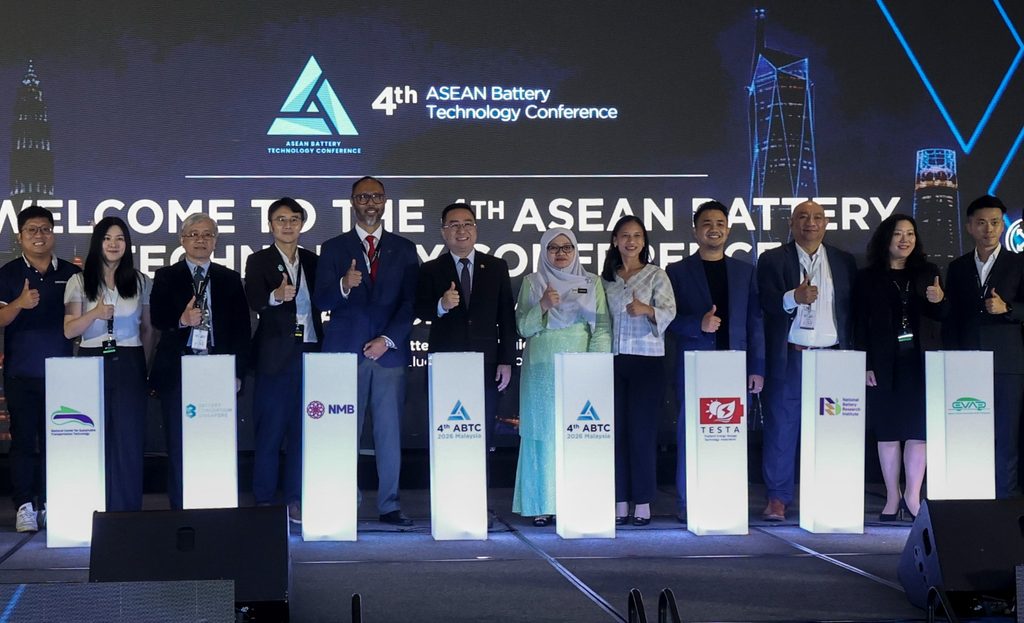
Malaysia’s Minister of Science, Technology and Innovation Datuk Chang Lih Kang made the call at the opening of the 4th ASEAN Battery Technology Conference (ABTC 2026) in Sepang, stressing that growing demand from electric mobility and energy storage presents ASEAN with an important opportunity to develop a stronger regional battery value chain.
From Discussion to Industrialisation
As global demand for batteries accelerates, ASEAN is increasingly looking beyond its traditional role as a supplier of raw materials.
Chang said the region must now focus on turning its existing capabilities into industrial-scale production, with ASEAN countries complementing one another through research, manufacturing, standards development, investment and market integration.
The opportunity is significant. Southeast Asia possesses valuable mineral resources, established automotive and electronics manufacturing ecosystems, and a rapidly growing market for electric vehicles and renewable-energy storage.
However, capturing more value from the battery economy will require ASEAN to strengthen the entire supply chain — from materials and research to cell manufacturing, battery management, recycling and commercial deployment.
Malaysia and Indonesia Launch Joint Battery Innovation
A major development unveiled during ABTC 2026 was a new Malaysia–Indonesia NMC-graphene pouch cell, jointly developed by NanoMalaysia Berhad and Indonesia’s National Battery Research Institute (NBRI).
The initiative combines Indonesia’s capabilities in nickel-manganese-cobalt active materials with Malaysia’s expertise in battery formulation, graphene technology and cell development.
The collaboration builds on a memorandum of understanding signed during ABTC 2025 covering technology transfer, joint research, testing, standardisation and industrial training.
The project demonstrates how ASEAN countries can combine complementary strengths rather than developing battery industries independently — potentially creating a more integrated regional manufacturing ecosystem.
Scaling Technology Into Commercial Applications
NanoMalaysia Group Chief Executive Officer Prof (Adj) Dr Rezal Khairi Ahmad highlighted commercialisation as one of the region’s most important next steps.
Malaysia has been developing infrastructure capable of moving battery technologies from research towards pilot production and industrial applications, but building a competitive battery economy will require cooperation across multiple ASEAN markets.
This transition is critical because technological capability alone does not automatically create industrial competitiveness.
ASEAN will need sufficient manufacturing scale, investment, skilled talent, testing infrastructure and market demand to transform laboratory innovations into commercially viable products.
New Partnerships Strengthen the Regional Ecosystem
ABTC 2026 also saw several collaborations covering battery energy storage systems, advanced materials, recycling, manufacturing and digital technologies.
Companies involved included GigaFactory Malaysia, Milan Utama, Ampace, Green Tenaga, Go Rental Singapore, Axium Industries and Montavista Energy Technologies. The partnerships are intended to advance battery and energy-storage technologies, improve manufacturing efficiency and explore commercial applications.
These collaborations indicate that ASEAN’s battery ambitions are broadening beyond electric vehicles.
Battery technology is becoming increasingly important for renewable-energy integration, data centres, industrial operations, telecommunications and grid-scale energy storage — creating multiple sources of regional demand.
Battery Demand Creates Major Economic Opportunity
Southeast Asia’s battery market is projected to expand substantially as electric mobility and renewable-energy deployment accelerate.
Recent industry estimates place the Southeast Asian lithium-ion battery market at approximately US$8.32 billion in 2026, with projections suggesting it could reach US$16.27 billion by 2031.
Indonesia’s nickel resources, Thailand’s automotive manufacturing capabilities, Vietnam’s electronics ecosystem and Malaysia’s growing battery and semiconductor industries give ASEAN several potential building blocks for a competitive regional value chain.
The challenge is connecting those strengths.
Instead of exporting raw materials and importing higher-value battery products, deeper regional integration could allow ASEAN economies to retain more of the economic value created through processing, manufacturing, technology development and recycling.
Safety, Standards and Circularity Take Centre Stage
Industrial expansion must also be accompanied by stronger standards and safety frameworks.
Held from 19 to 21 August 2026, ABTC 2026 focuses on key issues including manufacturing scale-up, battery safety, certification, circularity, investment and market deployment.
These areas will become increasingly important as battery deployment expands across electric vehicles and energy-storage systems.
Regional standards could help manufacturers access multiple ASEAN markets more efficiently, while stronger recycling capabilities could recover valuable materials and reduce dependence on imported battery inputs.
Circularity therefore represents not simply an environmental objective but a potential strategic advantage for ASEAN’s future battery supply chain.
Building an ASEAN-Wide Battery Ecosystem
International Battery Center CEO Ts Dr Nurul Akmaliah Dzulkurnain highlighted ASEAN’s complementary capabilities across policy, research, manufacturing, safety and deployment, noting that connecting these strengths could support a more resilient and competitive regional battery ecosystem.
That regional approach could become increasingly important as global competition intensifies.
ASEAN does not need every member state to replicate the entire battery supply chain. Instead, different economies could specialise in areas where they possess competitive advantages — from critical minerals and advanced materials to manufacturing, electronics, research, recycling and energy-storage deployment.
Such specialisation could create a more interconnected production network while increasing intra-ASEAN trade and investment.
Looking Ahead
The message emerging from ABTC 2026 is increasingly clear: ASEAN’s next challenge is industrialisation.
The region already possesses many of the resources, manufacturing capabilities and growing markets required to participate in the global battery economy. What matters now is transforming those individual advantages into a coordinated and commercially competitive regional ecosystem.
As electric vehicles, renewable energy and energy-storage systems drive battery demand higher, deeper cooperation in manufacturing, technology, standards, investment, commercialisation and recycling could enable ASEAN to capture significantly more value from the global energy transition.
Moving from research and discussion towards industrial-scale production could ultimately position Southeast Asia not merely as a supplier to the global battery industry, but as an increasingly important developer, manufacturer and market for next-generation energy technologies.