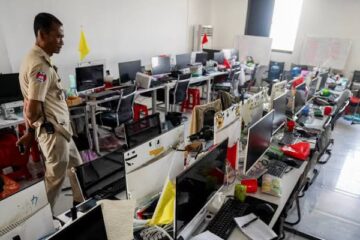
Widespread flooding across the Philippines is adding another layer of pressure to an economy already facing slower growth, weakened infrastructure spending and investor concerns linked to a major public-works corruption scandal.
According to The Business Times, recent storms and severe flooding have affected approximately 9.4 million Filipinos, including communities across Central Luzon, Calabarzon and Metro Manila — regions that contain some of the country’s most important manufacturing, logistics and commercial centres.
The disruption comes at a challenging time for the Philippines as it seeks to strengthen its position in Southeast Asia’s manufacturing landscape and capture a larger share of investment generated by companies diversifying supply chains across ASEAN.
Flooding Hits Key Economic Corridors
The latest weather disruptions have affected 2.7 million families across more than 6,300 villages, according to the Philippines’ Office of Civil Defense. More than 71,000 people were being accommodated in evacuation centres as authorities continued relief and recovery operations.
The economic significance extends beyond immediate damage to homes and communities.
Central Luzon and Calabarzon are major industrial regions, while Metro Manila remains the country’s principal business and services centre. Repeated flooding can disrupt factories, employee mobility, logistics networks, retail activity and the movement of goods between production zones and ports.
For companies considering long-term manufacturing investments, climate resilience is increasingly becoming part of the assessment alongside labour availability, operating costs, infrastructure quality and regulatory stability.
Economic Growth Has Already Slowed
The flooding comes as Philippine economic growth has weakened substantially.
Official data from the Philippine Statistics Authority showed that GDP expanded by just 2.3 per cent year-on-year in the second quarter of 2026, following 2.8 per cent growth in the first quarter. Growth for the first half therefore stood at around 2.6 per cent.
The industrial sector contracted by 2.4 per cent year-on-year, while gross capital formation fell 9.2 per cent, highlighting weakness in investment activity. Manufacturing, however, still expanded by 2.6 per cent during the quarter.
The Philippine government has lowered its full-year 2026 growth target to 3.5 to 4.5 per cent, reflecting the combined impact of higher energy costs, slower government spending and uncertainty surrounding infrastructure projects.
The World Bank is similarly projecting growth of 3.7 per cent for 2026, while expecting an improvement to 5.2 per cent in 2027 if policy responses successfully restore confidence and support investment.
Flood-Control Scandal Creates Wider Economic Effects
The latest flooding has drawn renewed attention to the country’s flood-control infrastructure at a time when the sector is already undergoing intense scrutiny.
A large-scale investigation into alleged irregularities involving public works and flood-control projects has led to tighter project validation and a slowdown in infrastructure spending. Previous investigations raised allegations involving overpriced, substandard or non-existent projects, although individual allegations remain subject to legal proceedings.
The economic consequences extend beyond the projects under investigation.
When public infrastructure programmes are delayed, the impact can spread to construction activity, employment, contractors, material suppliers and private investment. More importantly, questions surrounding procurement and project governance can weaken confidence among investors assessing the reliability of the country’s infrastructure environment.
The World Bank has identified uncertainty surrounding infrastructure procurement as one factor reducing fixed investment and private-sector confidence, alongside high global energy prices.
Flood-Control Spending Faces a Difficult Balance
The Philippines now faces the challenge of strengthening oversight without creating prolonged infrastructure paralysis.
Following the corruption scandal, new flood-control spending was frozen while projects underwent greater scrutiny. However, recent flooding has exposed the risks of leaving unfinished infrastructure unresolved.
In September, a Philippine Senate finance panel supported restoring funding for existing unfinished flood-control projects under the proposed 2027 budget, while maintaining restrictions on new projects.
The approach highlights the difficult policy balance facing the government: public spending must be subject to stronger accountability, but flood protection remains essential for communities and major economic areas increasingly exposed to extreme weather.
Improved project verification, transparent procurement and stronger monitoring could therefore become as important as the level of infrastructure expenditure itself.
Investor Confidence Becomes Critical to the Philippines’ ASEAN Position
The Philippines is competing with neighbouring economies to attract investment from multinational companies restructuring regional supply chains.
ASEAN has benefited significantly from the China+1 strategy, as companies establish additional manufacturing and sourcing operations outside China to diversify risk.
The Philippines has several competitive strengths, including a large workforce, English-language capability, an established electronics sector and growing industrial zones. However, investors increasingly compare these advantages against infrastructure reliability, regulatory predictability and climate resilience.
There are positive signals. The Philippine Board of Investments approved PHP461.84 billion in projects during the first half of 2026, up 21 per cent from the same period a year earlier.
The Philippine Economic Zone Authority separately approved PHP140.7 billion in investments in the first half, with electronics manufacturing among the leading sectors.
Yet converting investment approvals into actual capital deployment remains crucial. The Business Times previously reported that realised foreign direct investment had weakened even as investment pledges increased, underscoring the importance of restoring long-term business confidence.
Climate Resilience Is Becoming an Economic Competitiveness Issue
The latest floods also demonstrate why climate adaptation can no longer be viewed purely as an environmental policy.
Flood-resilient roads, drainage systems, transport networks and industrial zones directly influence whether factories can operate, workers can reach workplaces and businesses can move goods reliably.
For an archipelagic country regularly exposed to typhoons, heavy rainfall and flooding, infrastructure resilience is therefore closely connected to investment competitiveness.
The challenge is especially significant for manufacturing corridors where repeated disruption could increase operating costs and influence future location decisions by multinational companies.
Strengthening climate-resilient infrastructure could consequently serve two objectives at once: protecting communities while improving the reliability of the Philippines as an investment and manufacturing destination.
Governance Reform Could Help Rebuild Momentum
Restoring confidence will require more than restarting construction.
The World Bank has called for clear, transparent and consistently enforced infrastructure procurement standards, alongside broader reforms to lower the cost of doing business and encourage both domestic and foreign investment.
Stronger oversight could ultimately improve the quality of public investment by ensuring that funds are directed towards projects that deliver measurable protection and economic value.
For the Philippines, this creates an opportunity to transform the current crisis into a broader infrastructure reform effort — improving procurement, project evaluation, implementation and accountability while addressing urgent climate risks.
Looking Ahead
The Philippines enters the final months of 2026 facing a difficult combination of slower economic growth, extreme weather, infrastructure disruption and governance concerns.
The latest flooding shows how these challenges are increasingly interconnected.
Weak or delayed infrastructure can leave communities and industrial areas more exposed to severe weather. Flooding can then disrupt economic activity, while concerns over how infrastructure funds are managed can further weaken investment confidence.
Yet the country’s economic fundamentals and investment potential remain significant. The Philippines has recently achieved upper-middle-income status, continues to attract substantial investment commitments and remains strategically positioned within ASEAN’s expanding manufacturing and digital economy.
The immediate priority is therefore not simply increasing infrastructure spending, but ensuring that investment produces reliable, resilient and accountable public infrastructure.
Successfully combining stronger governance with climate resilience could help the Philippines restore investor confidence, protect its major economic corridors and compete more effectively for the next wave of regional investment.