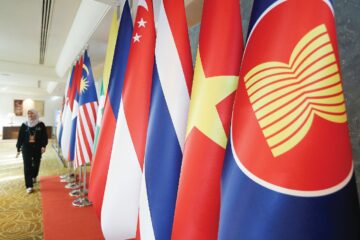
Economic ties between China and ASEAN are entering a deeper phase of integration as both sides work to bring the upgraded China–ASEAN Free Trade Area (CAFTA) 3.0 Upgrade Protocol into force, expanding cooperation beyond conventional merchandise trade into the digital economy, green development and regional supply-chain connectivity.
China–ASEAN trade reached 5.95 trillion yuan, approximately US$886 billion, during the first eight months of 2026, representing a 20.6 per cent year-on-year increase, according to data from China’s General Administration of Customs cited by China Daily and Asia News Network.
The rapid increase comes as companies on both sides deepen manufacturing, sourcing and consumer-market connections, reinforcing ASEAN’s role within China’s regional economic networks while creating additional opportunities for Southeast Asian businesses seeking access to the Chinese market.
CAFTA 3.0 Moves Towards Implementation
Momentum is being supported by the CAFTA 3.0 Upgrade Protocol, signed in Kuala Lumpur in October 2025.
China has said it is working with ASEAN Member States to bring the upgraded agreement into force at an early date while coordinating its implementation with the Regional Comprehensive Economic Partnership (RCEP).
The agreement represents the latest development in a trade relationship that began with the establishment of the China–ASEAN Free Trade Area framework in 2002. CAFTA was fully implemented in 2010, followed by an earlier upgrade protocol signed in 2015 and fully implemented in 2019.
CAFTA 3.0 substantially broadens the areas covered by the economic relationship. Its chapters include trade in goods, services, investment, rules of origin, customs procedures, competition and consumer protection, digital economy, green economy, supply-chain connectivity and support for micro, small and medium-sized enterprises.
This broader scope reflects the changing structure of China–ASEAN commerce, where digital services, technology infrastructure and interconnected manufacturing networks are becoming increasingly important alongside traditional trade.
Trade Relationship Becomes More Integrated
China and ASEAN have remained each other’s largest trading partners for six consecutive years, with bilateral trade exceeding US$1 trillion in 2025, according to China’s Ministry of Foreign Affairs.
The relationship is also becoming increasingly embedded in regional production networks.
Xu Liping, Director of the Chinese Academy of Social Sciences’ Center for Southeast Asian Studies, observed that Chinese companies are increasingly sourcing, manufacturing and selling within Southeast Asia, while ASEAN companies are gaining greater access to China’s extensive consumer and industrial markets.
This shift means trade growth is no longer driven simply by finished products moving between China and Southeast Asia. Components, raw materials, machinery and intermediate goods increasingly move multiple times across regional borders before reaching final consumers.
For businesses, closer integration can create opportunities to organise manufacturing and sourcing across several economies instead of relying on a single production location.
Digital Economy Becomes a New Growth Engine
Technology is emerging as one of the strongest areas of China–ASEAN economic expansion.
Rapid investment in data centres, cloud infrastructure, telecommunications and artificial intelligence across Southeast Asia is increasing demand for networking equipment and other digital infrastructure.
Fuzhou-based Ruijie Networks, for example, recorded exports to ASEAN markets of 1.44 billion yuan between January and August 2026, representing a 93 per cent increase from a year earlier. The company attributed growing demand partly to digital infrastructure and data-centre investment in markets including Singapore, Malaysia and Indonesia.
CAFTA 3.0’s inclusion of a dedicated digital-economy chapter could further support this momentum by providing a broader framework for cooperation as businesses increasingly depend on digital technologies to operate across borders.
For ASEAN, deeper digital cooperation could support investment in connectivity and technology-intensive industries while giving Southeast Asian firms additional opportunities to participate in regional digital supply chains.
Green Development Added to the Trade Agenda
The upgraded agreement also formally expands cooperation into the green economy.
This represents an important evolution from earlier trade arrangements centred largely on tariff reductions and market access.
As ASEAN and China invest in renewable energy, electric vehicles, energy storage, sustainable infrastructure and cleaner manufacturing, green industries are becoming increasingly connected to regional trade and investment.
CAFTA 3.0 provides a framework through which businesses and governments can pursue these emerging economic opportunities while strengthening cooperation in environmentally related industries.
Greater alignment in these areas could become increasingly important as manufacturers face pressure from international customers and markets to meet sustainability requirements throughout their supply chains.
Regional Supply Chains Continue to Deepen
The latest trade figures also demonstrate how closely connected Chinese and Southeast Asian manufacturing has become.
In China’s Fujian province, trade with ASEAN reached 159.14 billion yuan during the first seven months of 2026, increasing 4.9 per cent year-on-year.
Meanwhile, Futaihua Precision Industry in Shandong imported more than 300 million yuan worth of industrial components from Southeast Asian economies including Cambodia and Malaysia during the first eight months of the year — an increase of 320 per cent compared with the previous year.
ASEAN was also Shandong’s largest source of imports during the first seven months of 2026, supplying 196.66 billion yuan in goods, equivalent to 22.8 per cent of the province’s total imports.
These examples illustrate how regional trade is increasingly supported by two-way industrial relationships rather than a simple export-import model.
RCEP and CAFTA 3.0 Could Work Together
The interaction between CAFTA 3.0 and RCEP could further strengthen regional economic integration.
RCEP links ASEAN with China, Japan, South Korea, Australia and New Zealand under a wider regional trade framework, while CAFTA focuses specifically on economic relations between ASEAN and China.
Chinese Vice-Minister of Commerce Yan Dong said both sides intend to promote coordinated implementation of the two agreements to take bilateral economic and trade relations to a higher level.
For businesses, complementary trade frameworks can potentially reduce barriers surrounding rules of origin, customs procedures and supply-chain organisation, although the practical impact will depend on implementation by participating economies.
The ASEAN–China Plan of Action 2026–2030 similarly calls for timely implementation of the CAFTA 3.0 Upgrade Protocol alongside effective implementation of RCEP and stronger regional supply-chain connectivity.
China–ASEAN Expo Highlights New Areas of Cooperation
The 23rd China–ASEAN Expo, taking place in Nanning, Guangxi from 17 to 21 September 2026, is expected to place CAFTA 3.0 at the centre of its agenda.
The event will highlight business opportunities arising from the upgraded agreement while promoting cooperation in areas including the digital economy, green development and supply-chain connectivity.
The expo has long served as a platform connecting Chinese and Southeast Asian businesses, investors and government representatives.
Its focus this year reflects how the regional economic conversation is shifting from expanding trade volumes alone towards deeper integration in technology, sustainability and industrial networks.
Opportunities for ASEAN Businesses and SMEs
The inclusion of a dedicated MSME chapter in CAFTA 3.0 is particularly relevant for Southeast Asia, where smaller enterprises account for a substantial share of businesses and employment.
While major corporations can often navigate different customs, regulatory and market-access requirements, smaller firms typically have fewer resources available for cross-border expansion.
Improved trade facilitation, clearer rules and stronger digital connectivity could therefore help more ASEAN SMEs access regional markets.
At the same time, greater competition arising from deeper economic integration means companies will increasingly need to strengthen productivity, product quality and digital capabilities in order to capture those opportunities.
Looking Ahead
The 20.6 per cent increase in China–ASEAN trade during the first eight months of 2026 demonstrates the continuing momentum behind one of Asia’s most significant economic relationships.
CAFTA 3.0 now provides a broader framework for taking that relationship beyond traditional trade and investment into areas that are expected to shape the region’s next stage of development — including digital commerce, green industries, resilient supply chains and technology-driven manufacturing.
The scale of future gains, however, will depend on implementation. Ratification, practical trade facilitation and the ability of businesses to make effective use of the upgraded rules will determine how quickly the agreement translates into commercial opportunities.
For ASEAN and China, the next chapter of economic cooperation is therefore increasingly about more than expanding the value of goods crossing borders. It is about building an interconnected regional economy in which production, technology, investment and consumer markets become more closely linked.
If implementation progresses as planned, CAFTA 3.0 — working alongside RCEP — could further reshape Asia’s trade architecture and give businesses on both sides additional pathways to participate in one of the world’s largest and fastest-evolving regional economic networks.