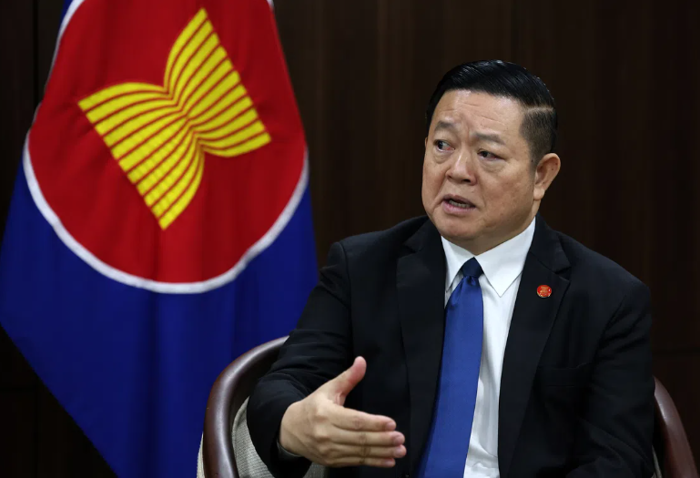
JAKARTA: ASEAN Secretary-General Kao Kim Hourn has urged Thailand and Cambodia to step up negotiations, warning that their fragile ceasefire could give way to renewed fighting. He also expressed confidence that Singapore’s ASEAN chairmanship in 2027 could help conclude negotiations on a South China Sea Code of Conduct.
In an interview with The Straits Times, Kao said limited progress in bilateral discussions had left the Thailand–Cambodia border situation vulnerable. He called on both countries to use the ceasefire to pursue a lasting settlement.
Renewed Diplomatic Efforts to Preserve the Ceasefire
According to the report, fighting along the countries’ approximately 800-kilometre border in July and December 2025 killed at least 150 people and displaced around one million, citing the International Crisis Group. A ceasefire agreed on 27 December 2025 has largely held, although both sides have alleged violations.
Kao urged greater use of existing channels involving foreign and defence ministries, military representatives and border authorities. He also highlighted ASEAN’s dispute-resolution mechanisms, including mediation, arbitration and the High Council established under the Treaty of Amity and Cooperation.
Following peace efforts led by Malaysia in 2025 and the Philippines in 2026, Singapore will take over leadership of the ASEAN Observer Team in 2027. Kao said Singapore’s diplomatic engagement could help advance negotiations, while emphasising that lasting peace ultimately depends on the two countries and the region itself.
Optimism Over a South China Sea Code of Conduct
Kao expressed confidence that Singapore could help ASEAN and China resolve their remaining differences over the South China Sea Code of Conduct, which aims to manage disputes and prevent conflict in the contested waters.
The report cited Philippine Foreign Secretary Theresa Lazaro as saying on 15 November that provisional agreement had been reached on approximately 80% of the draft’s paragraphs. Outstanding questions include the code’s legal nature and how its provisions would be implemented.
Kao said concluding the negotiations would require compromise from both ASEAN and China. Unresolved matters could be elevated to senior officials and foreign ministers to help reach an agreement acceptable to both sides.
Continued Engagement with Myanmar
On Myanmar, Kao acknowledged that ASEAN’s efforts had not met expectations but defended continued, carefully managed engagement. He stressed that Myanmar must also demonstrate its willingness to cooperate, adding that normal political engagement had not yet resumed.
ASEAN’s Five-Point Consensus, adopted in April 2021, remains central to its response. It calls for an end to violence, dialogue among all parties, humanitarian assistance and mediation through a special envoy.
Kao outlined three continuing priorities: reducing violence and restoring stability, providing humanitarian assistance without discrimination, and supporting an inclusive political process led and owned by Myanmar.
Digital Integration and Energy Cooperation
Beyond regional security, Kao identified the ASEAN Digital Economy Framework Agreement (DEFA) as a major priority for Singapore’s chairmanship. According to the report, the agreement was signed at the November summit in Manila, with attention now turning to ratification and implementation.
Member states are working towards a 180-day ratification timeframe, although differences in digital infrastructure and regulations may affect their readiness. Kao said countries prepared to proceed should be able to do so, while others could follow later. He highlighted potential opportunities for micro, small and medium-sized enterprises to participate more widely in the regional digital economy.
He also emphasised energy security and the ASEAN Power Grid, which aims to expand cross-border electricity trade and strengthen regional connectivity.
Singapore’s Chairmanship in ASEAN’s 60th Year
Singapore will formally assume the ASEAN chairmanship on 1 January 2027, following the handover from the Philippines at the Manila summit on 17 November. Its theme, “Deeper Integration, Wider Partnerships,” focuses on closer regional cooperation and stronger external relationships.
The chairmanship will coincide with ASEAN’s 60th anniversary and the second year of implementing ASEAN 2045: Our Shared Future. Kao expressed hope that Singapore would sustain regional momentum, advance key initiatives and help make 2027 a year of greater peace, stability and cooperation.