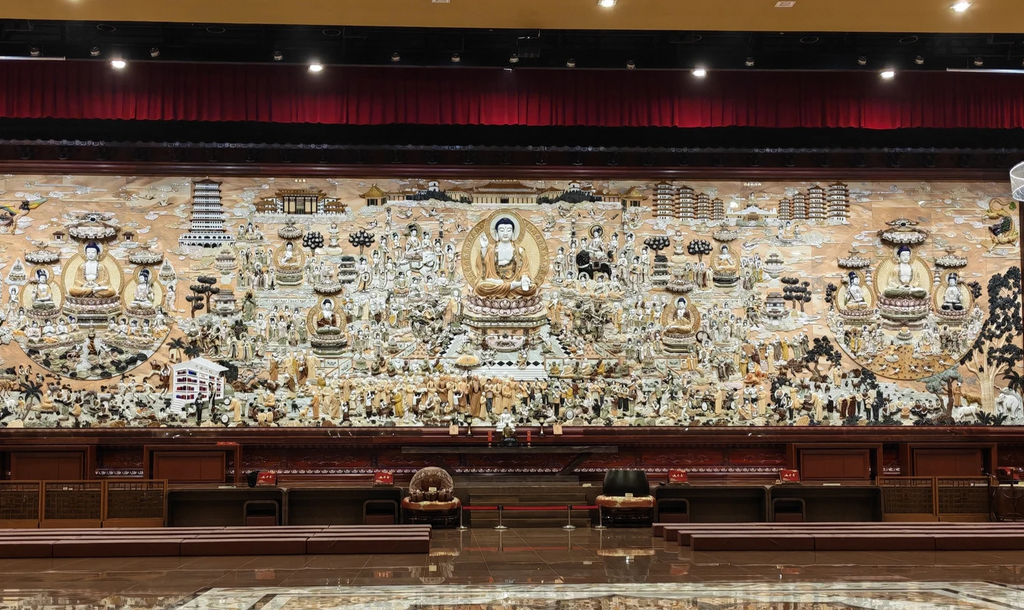
Fo Guang Shan Hsingma Si has been officially recognised by ASEAN Records for a monumental jade-inlaid relief wall mural that brings together Buddhist teachings, cultural symbolism and large-scale craftsmanship within one of Malaysia’s prominent Buddhist cultural and educational centres.
The temple achieved the official record title:
First and Largest Jade-Inlaid Relief Wall Mural Depicting the Propagation of Humanistic Buddhism
(355.74 m² measuring 36.3 m long and 9.8 m high, 420 sculpted figures across three thematic zones, completed 2018).
Located within the Main Shrine Hall of Fo Guang Shan Hsingma Si in Johor Bahru, the mural serves as both a major artistic installation and an educational visual narrative illustrating the principles, development and practical application of Humanistic Buddhism.
A 355.74-Square-Metre Visual Narrative
Known as the “Illustration of the Propagation of Humanistic Buddhism” (人间佛教行化图), the mural stretches 36.3 metres across and 9.8 metres high, covering a total surface area of 355.74 square metres.
Its composition incorporates 420 sculpted figures divided across three thematic zones, creating an expansive narrative that combines Buddhist worlds, Buddhas, Bodhisattvas, disciples and scenes associated with the development of Humanistic Buddhism.
The mural also illustrates how Buddhist principles are expressed through practical service, including education, Dharma propagation, environmental advocacy, disaster relief and community engagement.
Rather than functioning purely as decorative religious art, the work has been designed to communicate the philosophy of Humanistic Buddhism through imagery accessible to visitors, students and members of the wider community.
More Than 20 Varieties of Natural Coloured Jade
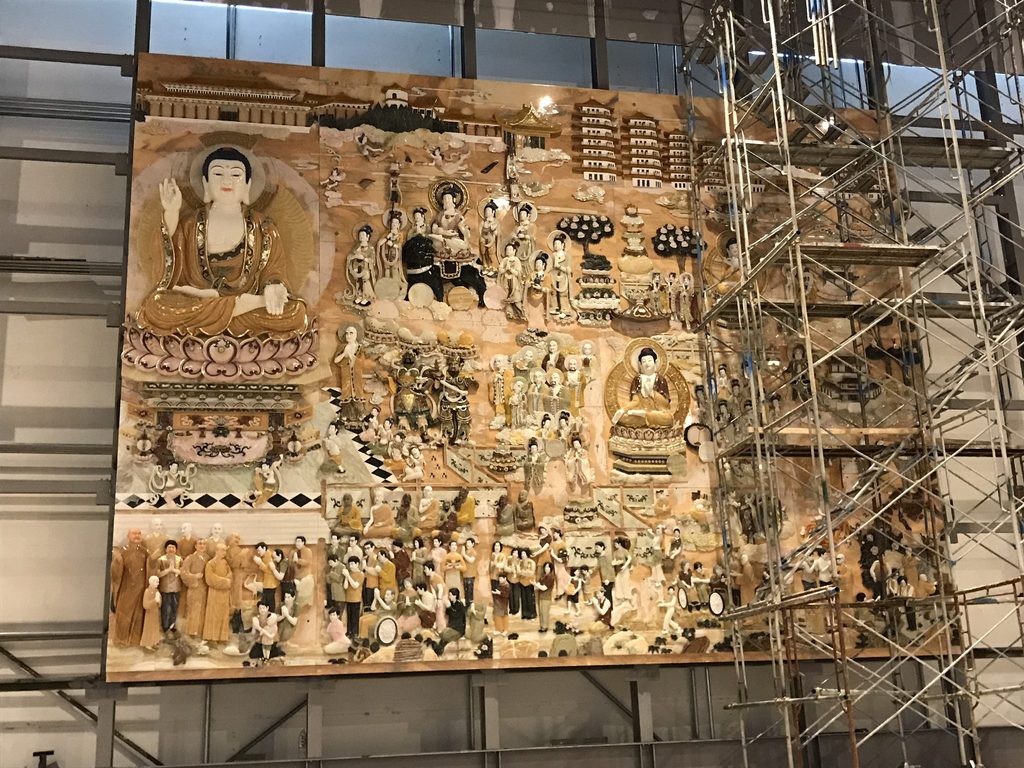
The scale of the mural is matched by the complexity of its materials and production.
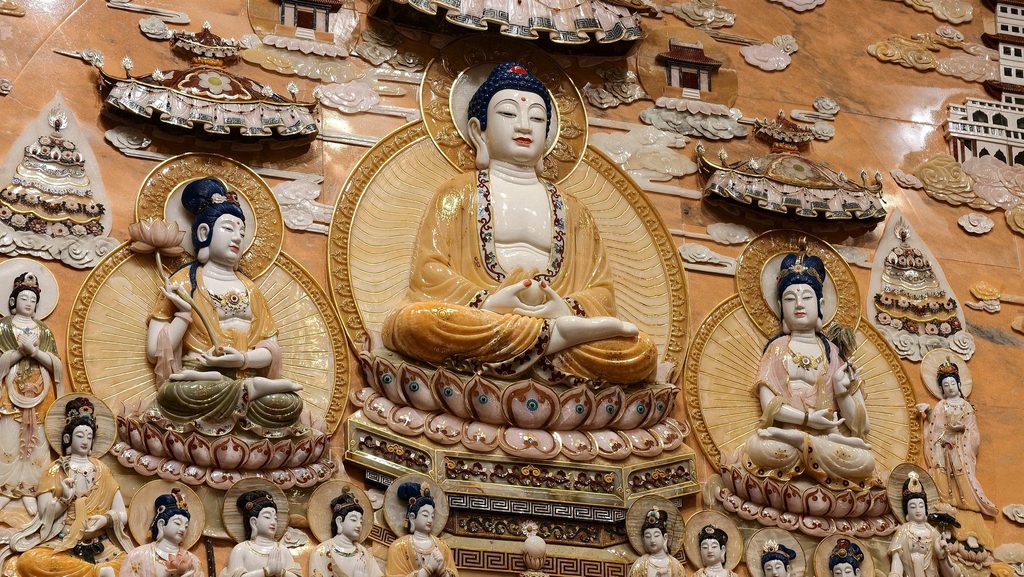
According to ASEAN Records, the installation was created using more than 20 varieties of natural coloured jade, carefully selected and integrated into figures, landscapes, architectural forms and symbolic elements throughout the composition.
The completed relief weighs approximately 42 metric tonnes, underscoring the considerable engineering and artistic coordination required to construct and install the work.
Its production involved multiple stages, including hand-drawn design, computer modelling, mould creation, carving, detailed sculpting, decoration, polishing and final assembly. The project took approximately two years to complete and involved dozens of craftspeople before reaching completion in 2018.
This combination of traditional craftsmanship and modern design processes allowed the mural to achieve both visual intricacy and architectural scale.
Three Thematic Zones Bring Buddhist Teachings to Life
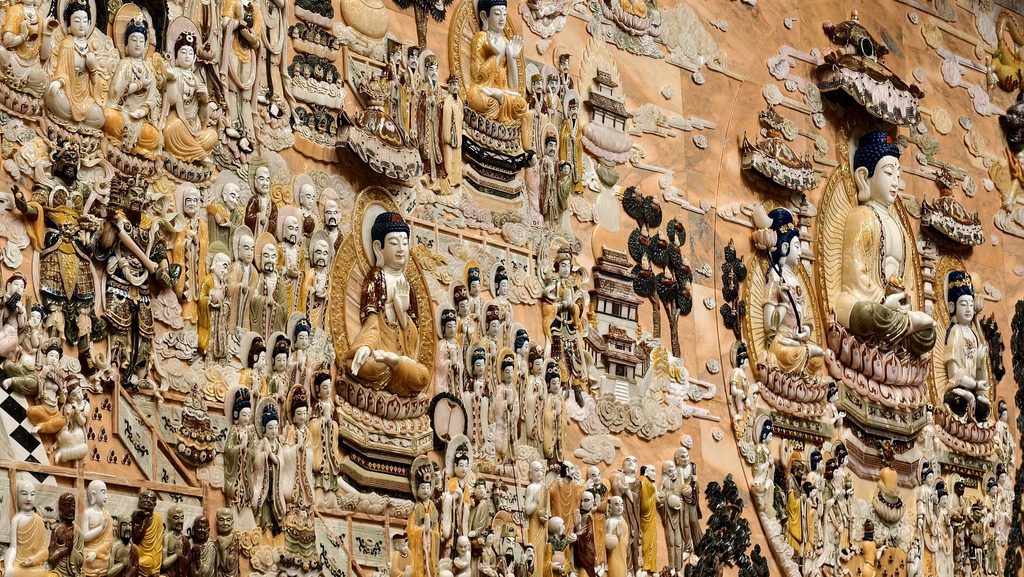
The mural’s 420 sculpted figures are organised across three thematic sections, allowing visitors to experience the work as a continuous visual journey rather than a single static image.
Religious figures are presented alongside scenes representing how Buddhist values are applied in contemporary society.
Through this structure, the mural reflects the wider concept of Humanistic Buddhism, which emphasises bringing Buddhist teachings into daily life and using them to support education, compassion, social service and personal cultivation.
The result is an installation that functions simultaneously as religious art, cultural documentation and public education.
Malaysian Identity Incorporated Into the Artwork
Although grounded in Buddhist history and teachings, the mural also incorporates visual references to Malaysia.
One notable example is the inclusion of the hibiscus, Malaysia’s national flower, connecting the wider Buddhist narrative with the local cultural environment in which Fo Guang Shan Hsingma Si operates.
This localisation gives the artwork a distinctive identity within Southeast Asia.
Rather than reproducing Buddhist artistic traditions without reference to place, the mural situates Humanistic Buddhism within a Malaysian context, reflecting the temple’s role in serving communities in southern Malaysia and neighbouring Singapore.
Reflecting Fo Guang Shan’s Four Major Objectives
The mural also expresses the broader philosophy promoted by Fo Guang Shan and its founder, Venerable Master Hsing Yun.
Its visual narrative reflects Fo Guang Shan’s four major objectives: promoting Buddhism through culture, fostering talent through education, benefiting society through charity, and purifying the human mind through spiritual practice.
These principles extend beyond the mural itself.
Fo Guang Shan Hsingma Si operates as a multifunctional cultural, educational and spiritual centre incorporating a Main Shrine Hall, classrooms, an art gallery, library, cultural spaces, meditation facilities and community-oriented areas.
Through these facilities and programmes, the temple functions not only as a place of worship but also as a platform for learning, cultural exchange and community engagement.
Recognition Presented During Mid-Autumn Festival Celebration
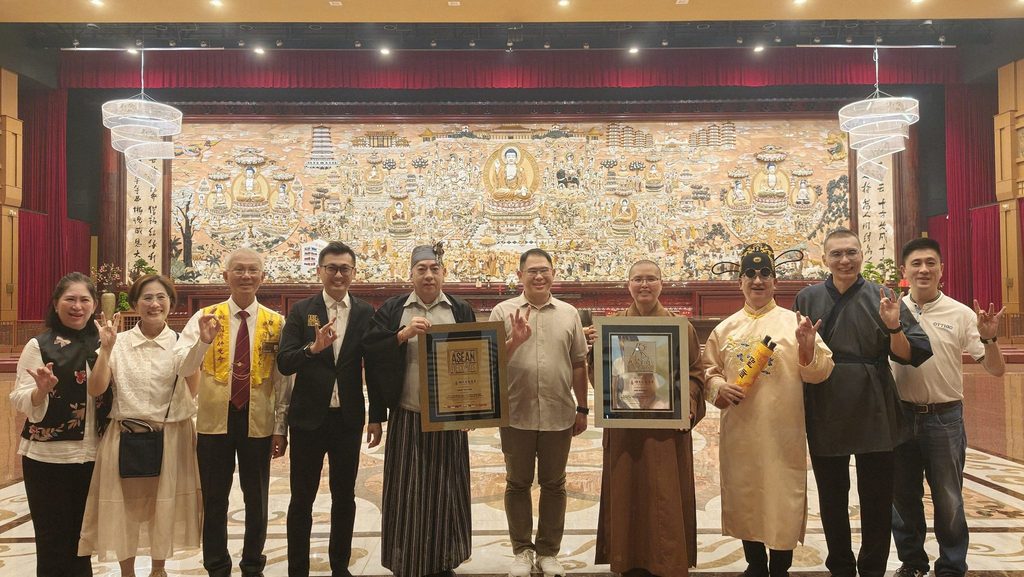
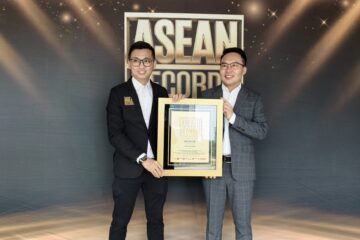
The ASEAN Records recognition was officially presented on 26 September 2026 at Fo Guang Shan Hsingma Si in Johor Bahru, during the temple’s Mid-Autumn Festival celebration.
The recognition was received on stage by Venerable Ru Bin, Abbess of Fo Guang Shan (Malaysia) Hsingma Si, representing the temple’s leadership and its continuing efforts to preserve and promote Humanistic Buddhism through culture, education and religious art.
The presentation was witnessed by YB Ling Tian Soon, Johor State Executive Councillor for Health and Environment.
The ceremony formally documented the exceptional scale of the mural while also drawing wider attention to its artistic, religious and cultural significance.
Recognition Extends Beyond Physical Scale
Reflecting on the milestone, Venerable Ru Bin emphasised that the recognition represents more than the mural’s dimensions.
She highlighted the collective contributions of the many people whose support enabled Fo Guang Shan Hsingma Si and its cultural initiatives to develop over the years. She also expressed hope that visitors would use the mural not only to appreciate Buddhist art but also to better understand how Humanistic Buddhism is expressed through culture, education, charity and service to society.
This perspective gives the record a broader meaning.
The measurable elements — including surface area, number of figures, material composition and overall weight — establish the scale of the achievement, while the mural’s wider significance lies in the teachings and community values it communicates.
A Cultural Attraction for Johor
YB Ling Tian Soon also highlighted the wider cultural role of Fo Guang Shan Hsingma Si, describing the centre as an important place for promoting culture as well as faith.
He noted that recognition of the monumental jade mural adds another meaningful cultural attraction that can be introduced to local visitors and travellers from neighbouring countries.
This creates an additional tourism dimension for Johor Bahru.
Large-scale religious and cultural artworks can contribute to destination identity by providing visitors with experiences that combine architecture, history, spirituality and craftsmanship.
The mural’s location near Singapore also positions Fo Guang Shan Hsingma Si to welcome visitors from across the southern ASEAN region.
Religious Art as a Form of Cultural Education
One of the mural’s most significant qualities is its ability to communicate complex religious ideas visually.
For visitors who may not be familiar with Humanistic Buddhism, the 420 sculpted figures and accompanying scenes provide a way to encounter Buddhist teachings through storytelling and artistic interpretation.
Visual narrative has historically played an important role in religious education across many cultures, enabling teachings to be communicated beyond written texts.
Fo Guang Shan Hsingma Si’s mural continues that tradition at a monumental scale, using jade relief sculpture to connect spiritual teachings with scenes of everyday service and contemporary social responsibility.
This makes the installation particularly relevant as both a cultural heritage work and an educational resource.
Preserving Craftsmanship Through Monumental Art
The mural also preserves specialised artistic skills.
Working with more than 20 varieties of natural coloured jade across a 355.74-square-metre surface requires expertise in material selection, carving, shaping, polishing and final installation.
The approximately two-year production process demonstrates how major cultural works can bring together multiple generations of artistic knowledge alongside newer techniques such as computer modelling.
This combination of traditional craft and contemporary production methods is increasingly important in cultural preservation.
It allows historic artistic traditions to remain active and relevant rather than being preserved solely within museums or archival collections.
Fo Guang Shan Hsingma Si’s Development in Johor
Fo Guang Shan Hsingma Si’s roots in Johor Bahru can be traced to Buddhist initiatives established during the 1990s. Following years of planning and development, construction of the current temple began in 2014, and in June 2015, Venerable Master Hsing Yun named the temple Fo Guang Shan Hsingma Si.
Since then, the centre has developed into a significant location for religious practice, education, arts, cultural programmes, meditation and community activities.
The monumental jade mural forms one of the centre’s defining artistic features, visually expressing the philosophy around which many of these activities are organised.
Looking Ahead
Fo Guang Shan Hsingma Si’s ASEAN Records recognition represents an important milestone in the documentation of large-scale Buddhist art and cultural heritage within Southeast Asia.
At 36.3 metres long, 9.8 metres high and weighing approximately 42 metric tonnes, the mural demonstrates exceptional physical scale. Its 420 sculpted figures, three thematic zones and use of more than 20 varieties of natural coloured jade further distinguish the work artistically and technically.
The mural brings together religion, craftsmanship, cultural education, Malaysian identity and community service, presenting Humanistic Buddhism as both a spiritual philosophy and a practical approach to everyday life.
As greater awareness of the mural brings more visitors to Fo Guang Shan Hsingma Si, the installation has the potential to serve as an enduring bridge between Buddhist teachings and the wider public — encouraging appreciation not only of monumental jade craftsmanship, but also of the values, stories and community traditions represented within it.
For Fo Guang Shan Hsingma Si, the ASEAN Records milestone therefore recognises more than one exceptional artwork. It documents a cultural undertaking created through years of collective effort and preserves, on a monumental scale, a visual story of Humanistic Buddhism, artistic heritage and service to society.
Learn more about this Official ASEAN Records Recognition